 Frisco Tree Care
Home › Tree Work › Tree Trimming and Clearance
Tree Trimming in Frisco: Roofs, Sidewalks and the Street
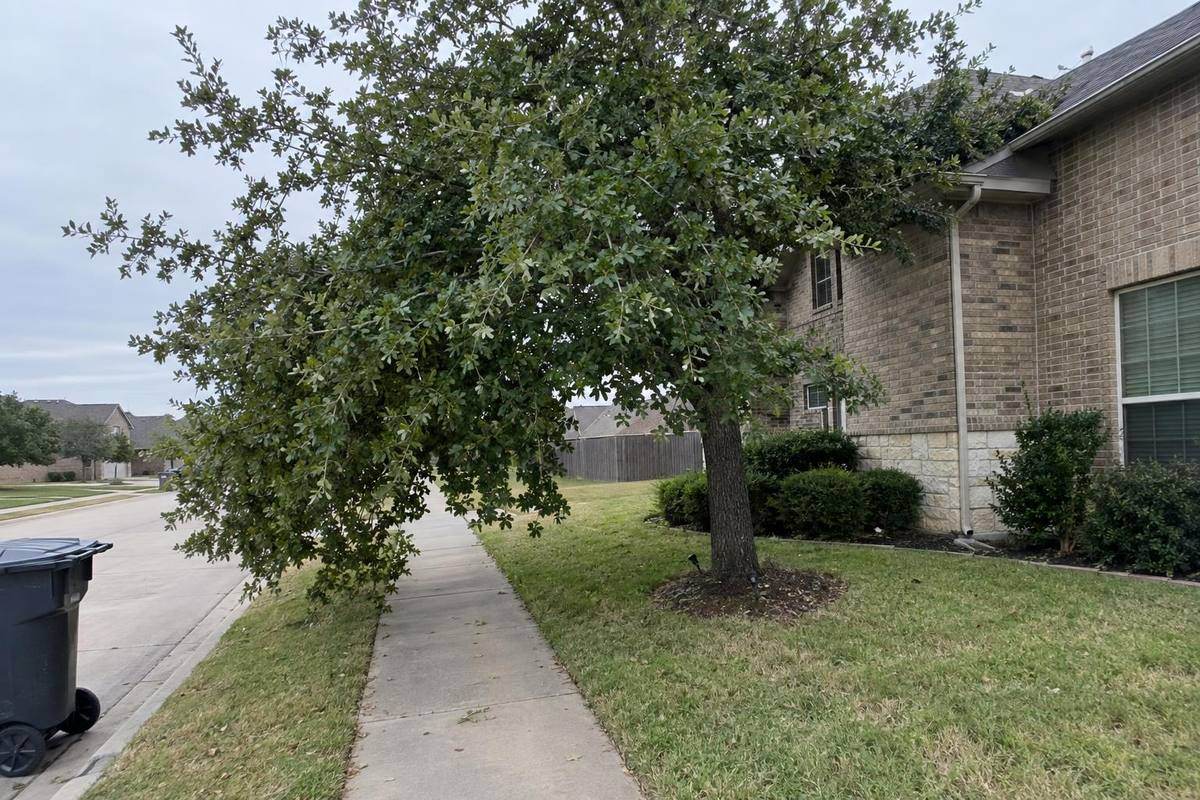
Planted four to six feet from the pavement and twenty feet from the house, a shade tree needs about fifteen years to reach both.
The Middle Years
Frisco had 33,714 residents in 2000 and 116,989 in 2010. The trees planted with that decade of houses are now 15 to 25 years old, which is the age when a canopy shade tree stops being a yard ornament and starts touching things.
The city's own planting rules explain where the trouble shows up. Required lot trees stand at least six feet behind the curb and four feet off any pavement, and one street tree can count toward the lot's total. That puts a great many trunks in the strip beside the sidewalk, with limbs that spread over the walk on one side and the street on the other. The backyard tree does the same thing to the roof and the fence.
Population: U.S. Census counts as given in the Handbook of Texas and Wikipedia entries for Frisco. Setbacks: City of Frisco Zoning Ordinance, landscape section.
What Clearance Trimming Covers
- Crown raising. Removing or shortening the lowest limbs so people, mowers and vehicles pass underneath. Done gradually, because a trunk stripped high in one visit is top-heavy.
- Roof and wall clearance. Cutting back to a side branch so limbs stop rubbing shingles and gutters. The cut goes to a branch that can take over, never to a stub.
- Deadwood. Dead limbs come out at any time of year on most species.
- Thinning for wind. Selective removal of crossing and crowded branches. Useful in moderation; a tree with only tufts of leaves at the branch ends has been over-thinned and is weaker for it.
- Reduction. Shortening a long, heavy limb back to a side branch to take weight off a weak attachment.
Topping is something else
Topping means cutting the main limbs back to stubs to make a tree shorter. It leaves large open wounds and a flush of weak shoots. Frisco's tree preservation rules point to the ANSI A300 pruning standard for work on protected trees, and that standard does not treat topping as pruning. If a crew proposes it, ask what the alternative would be.
Whose Job Is the Tree by the Street?
The honest answer is that it depends on the subdivision. In some, the HOA maintains street trees and common-area trees. In others the owner of the lot does. The plat, the HOA's documents and the HOA manager are the places to check, in that order of speed. A crew can trim a tree for whoever is responsible for it; it cannot settle who that is.
If the limbs that need trimming are near an overhead power line, stop there. Oncor's published rule is that only line-clearance personnel it has approved may work within six feet of a high-voltage line. See the page on trees near power lines for what each utility does and what is left to the owner.
Questions People Ask First
How much can be taken off at once?
Crews working to the industry standard remove a limited share of the live crown in one visit and less on an old or stressed tree. A quote that describes removing half the tree is describing a different job.
Is there a best season?
For most species, the dormant months are easiest on the tree and easiest to see structure in. Oaks have their own calendar because of oak wilt: avoid February through June.
Will the city pick up the branches?
Only small amounts that you bundle yourself. Frisco's yard waste rules call for limbs cut to three-foot lengths in bundles of no more than 30 pounds, and the city states it has no program to remove whole or large portions of trees. A tree service hauls its own debris; confirm that it is in the quote.
Do I need the HOA's approval to trim?
Routine trimming rarely needs it, but some associations require approval for work on street trees or for removing large limbs. One email to the manager before the crew arrives settles it.
Limbs on the Roof or Over the Walk?
Describe where the tree stands and what it is touching. An independent tree service will call back to arrange a look.
Call (469) 200-6710 Use the Form