 Frisco Tree Care
Home › Tree Work › Ash Trees and Emerald Ash Borer
Ash Trees in Frisco and the Emerald Ash Borer
If there is an ash on your lot, the question is no longer whether the beetle is in the county. It is.
Where Things Stand
On June 3, 2024, Texas A&M Forest Service announced that beetles collected in Collin County that May had been confirmed as emerald ash borer. The agency says most infested ash trees die within two to five years, and that every ash species is vulnerable.
In August 2026 the same agency reported the insect in five more Texas counties. It is still spreading.
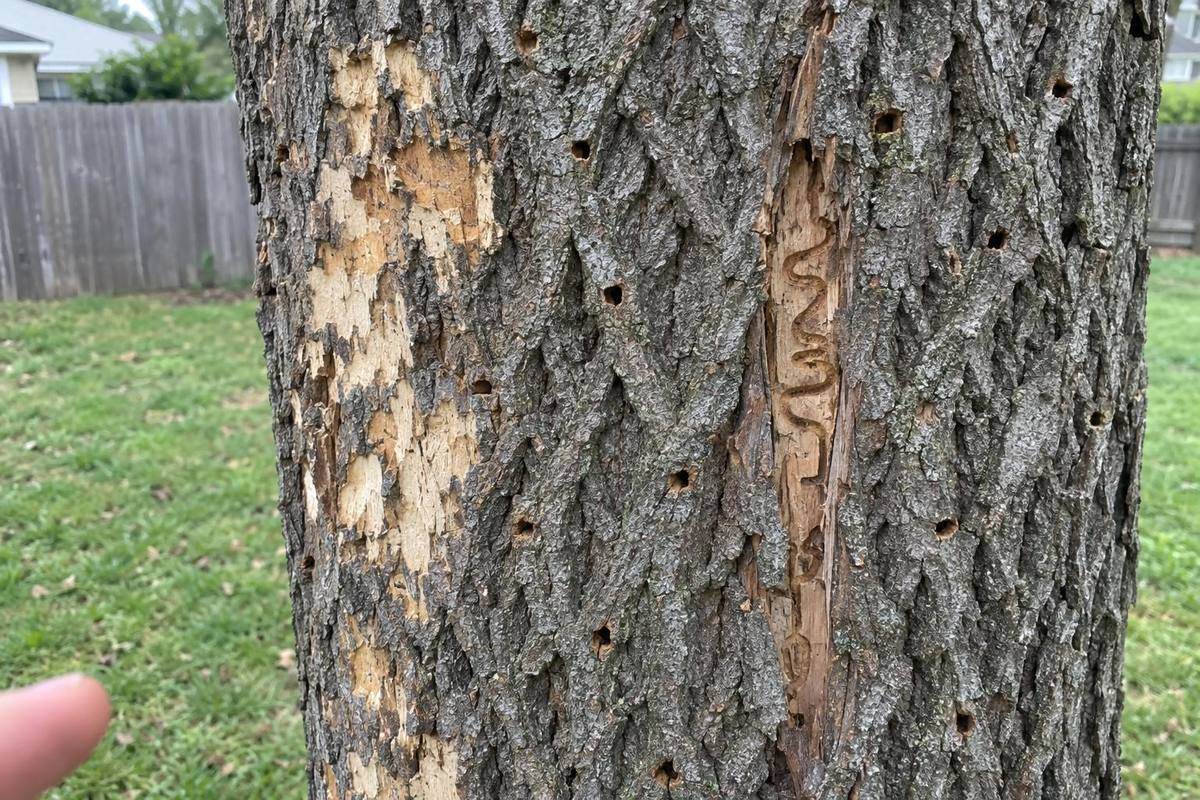
The beetle's larvae feed under the bark, cutting winding S-shaped tunnels through the layer that moves water and nutrients. A tree can carry them for a couple of years before the crown shows it. By the time the top is thin, much of the damage is done.
Texas A&M Forest Service announcements of June 3, 2024 (as reported by NBC DFW) and August 20, 2026.
Is Your Tree an Ash?
Ash has been planted in North Texas yards for years because it grows fast and shades a lot quickly. How many Frisco builders used it is not something this site could find counted, so check your own tree:
- Leaves are compound: five to nine leaflets along one stalk, with a single leaflet at the tip.
- Branches and buds sit in opposite pairs, directly across the twig from each other. Most other shade trees here alternate.
- Bark on a mature trunk has a tight diamond pattern of ridges.
- Seeds, when present, hang in clusters of narrow single-winged paddles.
Signs the Forest Service lists
- Thinning at the top of the crown
- Bark splitting
- Heavy woodpecker activity, with pale patches where outer bark has been flaked away
- D-shaped exit holes in the bark, each only a few millimeters across
The agency runs an emerald ash borer hotline at 1-866-322-4512 for reporting suspected infestations.
Treat It or Remove It
There are two workable answers and one bad one. A healthy ash in a good spot can be protected with systemic insecticide, repeated on a schedule for as long as the tree is kept. An ash that is already thin, badly placed or not worth the recurring cost should be removed while it is still alive. The bad answer is waiting: dead ash wood turns brittle quickly, which makes a later removal slower and more hazardous for the people doing it.
Treatment is licensed work. Applying insecticide to a customer's tree for pay in Texas takes a Texas Department of Agriculture applicator license. A tree service that offers ash treatment should name the license holder. A crew without one can still inspect, prune and remove.
Ash wood from a quarantined county is not supposed to travel. Ask the crew where the wood and chips will go, and do not give ash firewood to someone who will drive it across the state.
Questions People Ask First
Should I remove a healthy ash now?
Not automatically. If it is sound and you are willing to pay for treatment every cycle, it can be kept. If you would not pay for that, removing it on your own schedule is cheaper and safer than removing it dead.
How do I find out for certain that it is infested?
An ISA Certified Arborist can inspect it. That is a voluntary professional credential, searchable in the ISA's public directory, and worth asking for on this question.
My neighbor's ash is dying. Is mine next?
The beetle flies, so nearby ash trees are at risk. That is the moment to decide between treating and removing yours.
Does the city remove ash trees?
On private lots, no. Trees in parks and medians are the city's; street trees may be the HOA's or yours, depending on the subdivision.
Not Sure It Is an Ash?
Describe the leaves and the bark, or just say you are unsure. An independent tree service can identify it on a visit.
Call (469) 200-6710 Use the Form